A computer for a child means learning, games, communication and, unfortunately, risks too: inappropriate sites, unchecked hours in front of the screen, accidental purchases and strangers in chats. Parental controls on a Windows computer help you not to forbid but to see the whole picture and steer it gently: how much time the child spends at the PC, what they do, which sites they open and what they install.
In this article we will go step by step: what the built-in Windows parental controls can do, how to turn them on in a few minutes, where their limits are and which third-party programs close those gaps. No scare tactics and no "spyware" extremes, just what really works for a family.
- Windows 10 and 11 have free parental controls, Microsoft Family Safety: time limits, site filtering, activity reports.
- They require Microsoft accounts for the parent and the child, and the child must sign in under their own account.
- Built-in controls are enough for basic tasks; their weak spots are being bypassed through a second browser or another account, and the lack of screenshots and a detailed log.
- Third-party programs offer more: screen screenshots, an app and site history, activity time, alerts.
- Install controls on your own child's computer and do it honestly, this is care, not surveillance.
What parental controls on a computer are
Parental controls are a set of tools that help a parent understand and limit how a child uses the computer and the internet. Usually it comes down to four things: screen time limits, site and app filtering, activity reports and purchase restrictions. The goal is not a total ban but reasonable boundaries and an understanding of what the child is doing at the PC.
One thing matters from the start: controls work better when they are open. A child who knows about the rules and limits takes them more calmly than one who one day discovers secret surveillance. So parental controls are about trust and agreements, and the technical tools only help to keep them.
Built-in Windows parental controls: Microsoft Family Safety
In Windows 10 and Windows 11 parental controls are built in and free, and they are called Microsoft Family Safety. They can limit computer time by day and hour, filter sites and apps by age, show activity reports and require a parent's approval for purchases in the Microsoft Store.
The key requirement: both the parent and the child must have a Microsoft account, and the child must sign in to Windows under their own child account. Without this the built-in controls will not work.
How to turn on parental controls in Windows 10 and 11: step by step
- Create a separate Microsoft account for the child (or use an existing child account).
- Open Settings → Accounts → Family and click "Add a family member" → "Child".
- Send the invitation to the child's email and confirm it.
- Sign in to family.microsoft.com under your account, this is the family management center.
- Set up what you need: screen time, content filters, app and game restrictions by age, email reports.
- Make sure the child signs in on the computer under their own child account, otherwise the rules do not apply.
After that you will receive summaries: how much time the child spent at the PC, which apps and sites they opened, and you will be able to change limits remotely through the website or the Family Safety app on your phone.
Limits of the built-in parental controls
Microsoft Family Safety covers the basics, but it has noticeable weak spots worth knowing about honestly:
- It can be bypassed by switching accounts. If the child signs in under another (or local) account, the rules do not apply.
- Site filtering works mainly in Microsoft Edge. Through a third-party browser some restrictions can be bypassed.
- No screenshots and no detailed log. You see summary reports but not what exactly happened on the screen.
- Microsoft devices and services only. An online account and a constant connection to Microsoft services are required.
For younger children the built-in controls are usually enough. But if the child is older and tech-savvy, or it matters to you to see a fuller picture of activity, the built-in tools are not enough, and then you add third-party programs.
Third-party parental control programs for Windows
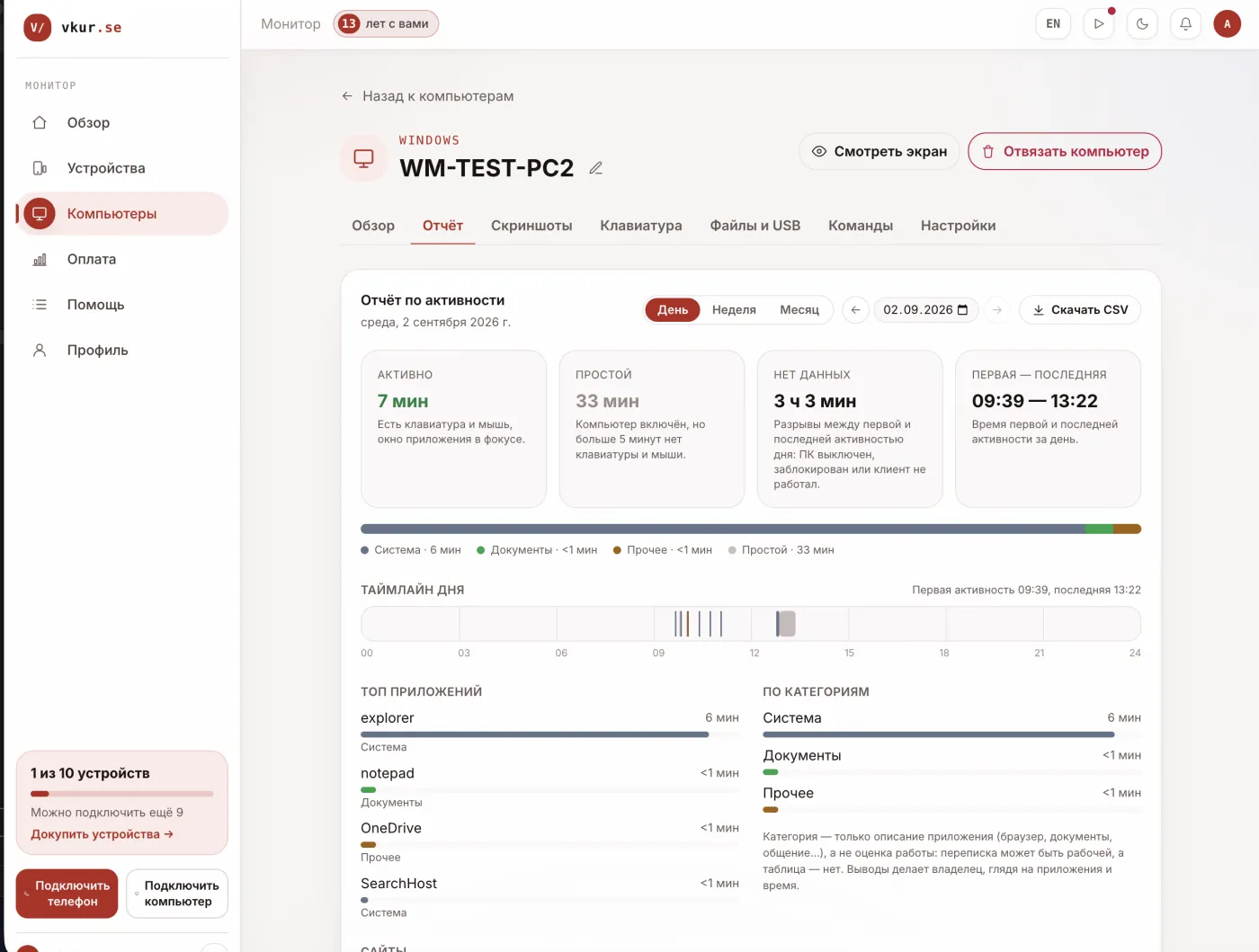
Dedicated programs are installed on the computer and give what the built-in controls lack: screen screenshots with a history, a detailed log of apps and sites with time, tracking of activity and idle periods, alerts. They work regardless of which account or browser the child is using.
One such program is VkurSe for Windows. You install a small app on the child's home computer, and you see the data in a personal dashboard from any device: screen screenshots by day, which programs were used and for how long, visited sites, typed text, and activity and idle periods during the day. This is handy when it matters not just to limit time but to understand exactly what the child is doing at the PC.
Built-in controls or a third-party program: a comparison
| Feature | Microsoft Family Safety | VkurSe for Windows |
|---|---|---|
| Screen time limit | Yes | Data collection schedule |
| Site filter | Yes, mainly in Edge | History of visited sites |
| Screen screenshots | No | Yes, with a history by day |
| App and time log | Summary only | Detailed, with activity and idle periods |
| Works without a Microsoft account | No | Yes |
| Phones and PCs in one dashboard | Partially | Yes, a shared device list |
A sensible approach is to combine them: turn on the built-in Family Safety for time limits and age filters, and for a full picture of activity on the home PC install a separate program.
How to set up parental controls on a child's computer in a few minutes
Using VkurSe for Windows as an example:
- Create a personal dashboard and open the "Computers" section.
- Click "Connect a computer" and get a linking code.
- Download the program and install it on the child's home computer.
- Enter the code, the computer will appear in the dashboard and data will start arriving.
After that you simply open the dashboard from your phone or your own PC and see the activity. If the family also has children's phones, they show up next to the computers in one device list, which is handy for keeping everything in one place.
Ethical and legal: control is care
Parental control over your own minor child is legal and natural: parents are responsible for their children's safety. But it is more humane when control is open. Explain to the child why you are turning on limits and oversight, agree on the rules, that way it works as care and trust rather than secret surveillance. Install programs only on your own family's devices.
Frequently asked questions
Does Windows have free parental controls?
Yes. Windows 10 and 11 include Microsoft Family Safety, it is free, can limit time, filter sites and apps and send reports. It requires Microsoft accounts for the parent and the child.
Can the built-in parental controls be bypassed?
Technically yes, for example by signing in under another account or through a third-party browser. That is why for older children the built-in controls are often supplemented with a separate program that works regardless of account and browser.
What is best to install for full computer control?
For basic limits Family Safety is enough. If you need to see screen screenshots, a detailed app and site history and daily activity, install a third-party program, for example VkurSe for Windows, where all of this is available in the personal dashboard.
Will parental controls slow down the computer?
No. Both the built-in tools and lightweight control programs put almost no load on the system: they run in the background and send data in small portions.
Conclusion
Start with the built-in Microsoft Family Safety, it is free and covers the basics: time limits, age filters and reports. If the child is older or you need a full picture of what happens on the home PC, add a third-party program with screenshots and a detailed log. And most importantly, keep control open: agreements work better than bans, and technical tools only help to keep them.
VkurSe for Windows
Screenshots, apps, websites and computer activity in one dashboard. Phones and PCs together. First day free.
Try it freeCreate your dashboard — the Windows installer will be in the “Computers” section